Choosing an Air Conditioning Contractor for HVAC Work
Hiring an air conditioning contractor should not feel like auditioning magicians. Yet plenty of homeowners and building managers end up standing in a mechanical room, nodding solemnly while someone points at copper lines, ductwork, refrigerant gauges, wiring, condensate drains, and a furnace that has chosen violence. The vocabulary alone can make the whole thing feel like a secret society with tool belts.
The good news is that HVAC work is not mystical. It is a real trade, with defined tasks, real standards of practice, and consequences you can feel in your living room, utility bill, and patience. The less good news is that not every contractor explains the work clearly, and not every low bid remains low once the job starts growing extra limbs.
An air conditioning contractor’s core business is installing and maintaining heating, ventilation, and air conditioning equipment. That may sound tidy, but in the field, HVAC work often overlaps with plumbing and electrical tasks tied to heating and cooling equipment. A heat pump installation may involve refrigerant handling, electrical connections, condensate drainage, equipment sizing, airflow decisions, and thermostat controls. A furnace repair service may uncover a venting issue. An air conditioning repair service may trace a “bad unit” complaint to a wiring problem or a clogged drain. Mechanical systems do not respect the neat categories we use on business cards.
That is why choosing the right contractor matters. You are not just buying a cold breeze. You are hiring judgment.
What an air conditioning contractor actually does
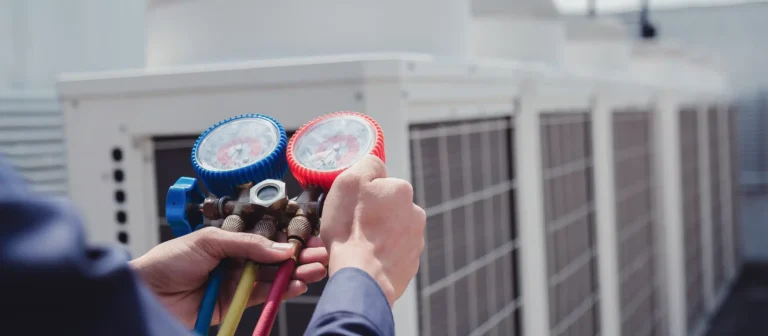
A qualified air conditioning contractor handles the installation, maintenance, and repair of air conditioning systems, heat pumps, and related HVAC equipment. That can include air conditioning maintenance before the cooling season, an air conditioning tune-up to check operation, air conditioning repair when the system quits, and full replacement when repair no longer makes sense.
The work often touches more than one trade. HVAC contractors may perform plumbing or electrical work associated with heating and cooling equipment, depending on licensing and local rules. That does not mean every HVAC company is also the right plumber, electrician, lighting contractor, or septic system service. It means many HVAC jobs have practical crossover points.
For example, an air conditioner produces condensate. That water has to go somewhere, preferably not into the ceiling over your dining table like a moody indoor raincloud. Drain lines may clog. Pumps may fail. Pans may rust. What starts as air conditioning repair can drift into drainage work. A heating contractor dealing with a furnace may also need to understand electrical controls and fuel connections. A heat pump installation may require careful attention to both refrigerant charging and electrical service.
The best contractors do not pretend every problem is the same problem. They diagnose. They explain. They know where their license and competence begin, and where another professional should enter the chat.
The contractor who asks questions is usually worth listening to
A rushed contractor can make you feel efficient for about nine minutes. Then you discover the quote was built on vibes and a flashlight glance.
A careful contractor asks how the system has been behaving. Does it run constantly? Does it short cycle? Are some rooms too warm while others feel like a walk-in cooler? Has the filter been changed? Did the trouble begin after recent remodeling, duct work, electrical work, or plumbing work nearby? Is this a recurring air conditioning repair, or the first time the system has acted up?
Those questions are not small talk. They reveal whether the person is thinking about the system as a system. HVAC equipment depends on sizing, airflow, refrigerant charge, controls, duct condition, drainage, and installation quality. If a contractor looks only at the outdoor unit and instantly declares the entire system dead, one eyebrow may rise. Possibly both.
Proper HVAC installation includes correct equipment sizing and refrigerant charging. That is not decorative trivia. An oversized unit can cycle too quickly, fail to manage comfort properly, and wear itself down. An undersized system can run endlessly and still leave people fanning themselves with unopened utility bills. Refrigerant charge also matters. Proper charging of an air conditioner or heat pump can reduce energy consumption and lower the risk of failure. In plain English, a sloppy installation can make new equipment behave like old equipment with better paint.
The lowest price is not always the cheapest job
Everyone loves a bargain until it arrives with missing parts, vague paperwork, and a technician who says, “That wasn’t included,” with the confidence of a game show host.
Price matters. No sane person wants to overpay for air conditioning maintenance, water heater repair, or a heat pump installation. But HVAC pricing reflects labor, equipment, warranty handling, diagnostic time, licensing obligations, parts availability, and sometimes the plain difficulty of reaching the equipment. A rooftop unit, a cramped attic, or a system wedged into a closet apparently designed by someone angry at future technicians will affect time and cost.
A low bid may be perfectly legitimate. Some companies run lean, some have better supplier relationships, and some jobs are straightforward. The danger comes when the quote is thin on detail. If one contractor includes equipment sizing, duct evaluation, refrigerant charging, condensate drainage, startup checks, and disposal of old equipment, while another simply writes “install AC,” those are not the same quote. One is a scope of work. The other is a fortune cookie.
When comparing bids, look for specificity. The contractor should describe what equipment is being installed, what work is included, what related items are excluded, and how they will handle surprises. HVAC systems are attached to houses and buildings, and buildings have opinions. Old wiring, inaccessible piping, poor drainage, damaged ductwork, and mystery modifications from 1997 can all affect the final job. A good contractor does not promise there will be no surprises. A good contractor explains how surprises are handled.
Credentials matter, but so does competence on the floor
The HVAC trade includes specialized contractors who design, install, maintain, and service residential, commercial, industrial, institutional, and governmental systems. That range is broad. A company excellent at residential air conditioning repair may not be the best fit for a large commercial ventilation project. A contractor who installs heat pumps every week may be sharper on that work than someone who treats heat pumps as an occasional side quest.
Refrigerant work has its own obligations. Air conditioners and refrigeration equipment fall under regulated appliance categories for maintenance, service, and repair. Technicians involved in that work may include installers and contractor employees. If refrigerant is involved, you want a contractor who treats it seriously, not as “the cold juice,” which is a phrase that should immediately reduce confidence.
Licensing rules vary by place, and this is where homeowners should avoid assuming. Ask directly what licenses apply to the work. If the job involves electrical connections beyond standard HVAC work, ask whether the company has an electrician on staff or uses a licensed electrical contractor. If gas piping or appliance fuel connections are involved, ask about gas installation service qualifications. If drainage or water connections are included, ask whether a plumber is part of the company or brought in when needed.
A polished truck is nice. A clear answer is better.
A short checklist before you hire
Use this as a practical filter when you are down to a few contractors and your brain has begun making modem noises.
- Ask whether the contractor regularly performs the exact work you need, such as air conditioning repair, air conditioning maintenance, furnace repair service, or heat pump installation.
- Request a written scope that explains equipment, labor, related plumbing or electrical work, exclusions, and warranty terms.
- Confirm how the contractor handles refrigerant charging, system startup, airflow concerns, and equipment sizing.
- Ask who performs any required electrical, gas, plumbing, drainage, or control work tied to the HVAC job.
- Notice whether the contractor explains trade-offs clearly or just pressures you to sign while the pen is still warm.
That is the whole checklist. Five items, no laminated binder required. If a contractor becomes annoyed by these questions, that is useful information. You have not wasted their time. They have saved yours.
Repair, maintain, or replace: the judgment call
Air conditioning repair makes sense when the equipment is otherwise sound, the problem is isolated, and the cost of repair does not approach the value of replacement. Air conditioning maintenance makes sense almost always, because neglected systems tend to become theatrical at the worst possible time. The hottest Saturday of the year is when weak capacitors, dirty coils, clogged drain lines, and tired motors decide to pursue solo careers.
An air conditioning tune-up is not a magic shield, but it is a sensible inspection and service visit. It can catch obvious issues, improve operation, and give you a clearer picture of system condition. A tune-up should not be treated as a sales ambush. If every maintenance visit ends with a dramatic declaration that your system is “on its last legs,” even when it is cooling properly, healthy skepticism is allowed. Systems do age and fail, but panic is not a diagnostic tool.
Replacement becomes more attractive when repairs stack up, comfort remains poor, energy use seems unreasonable for the building and climate, or major components fail. Still, replacement should be sized and installed properly. Swapping boxes without thinking about airflow, ductwork, refrigerant charge, and controls is like replacing a bad tire while ignoring the bent axle.
The best contractors will talk through options. They may say, “You can repair this, but I would not spend heavily on it,” or “This part is worth replacing, but let’s not pretend the system is new.” That kind of honesty feels less flashy than a discount banner, but it ages better.
When HVAC meets plumbing, drains, and water heaters
Many mechanical rooms are crowded little neighborhoods. The furnace sits near the water heater. The air handler has a condensate line. Pipes run through the same wall cavities as refrigerant lines. A clogged drain can mimic an HVAC failure. A leaking water heater can make a homeowner blame the nearest piece of equipment with a fan.
This is why companies that understand both HVAC and plumbing can be useful, provided they are properly qualified for the work. Plumbing leak repair, drain cleaning, rooter service, hydrojetting, water heater repair, water heater installation, plumbing repiping, and water softener installation are not the same as air conditioning work, but they often live in the same practical universe. When a condensate drain backs up, it may need clearing. When a mechanical room is being reworked, plumbing and HVAC sequencing matter. When a heat pump water heater or HVAC system shares space with plumbing equipment, access and drainage deserve thought.
That does not mean your air conditioning contractor should casually offer septic system service because the truck had room for one more sticker. Septic work is its own specialty. So is substantial electrical work. So is lighting contractor work. The right contractor recognizes connections between trades without pretending one toolbox conquers all trades.
A homeowner once told me her “AC was leaking.” The air conditioner was fine. The water heater had failed, and water was traveling along the floor toward the air handler like a tiny, expensive river. Another time, a cooling complaint traced back to a clogged condensate line that had tripped a safety switch. The equipment was not broken. It was simply refusing to create an indoor swamp. These are ordinary examples, not rare unicorn cases. Mechanical systems are close enough together that diagnosis must start with evidence, not assumptions.
The electrical side should not be hand-waved
Air conditioning systems need electrical power, controls, and safe connections. Heat pumps, furnaces with blowers, condensate pumps, thermostats, control boards, and outdoor units all involve electrical components. Some HVAC contractors handle the electrical work associated with their equipment. Some coordinate with an electrician. The important part is not the company’s internal org chart. The important part is that the work is done by someone qualified to do it.
If a contractor shrugs at electrical questions, that is not charming minimalism. It is a warning. Equipment can be correctly selected and still perform badly if the wiring, disconnects, controls, or electrical capacity are not handled properly. A lighting contractor is not automatically an HVAC electrician, and an HVAC technician is not automatically qualified for every electrical task in a building. Trade boundaries exist for reasons, most of them learned by people who heard buzzing noises they did not enjoy.
Ask how electrical work is included. If a new system requires changes beyond reconnecting existing equipment, the contractor should explain what will happen and who will do it. The same principle applies to gas installation service for heating equipment. The answer does not have to be dramatic. It just has to be clear.
Maintenance is where good contractors prove themselves quietly
Big installations get attention. Maintenance reveals character.
During air conditioning maintenance, a contractor should look at the system’s operation and condition, not merely change a filter and leave a sticker. The exact work depends on the equipment and setup, but the visit should be systematic. A technician should be able to explain what was checked, what looked good, what needs watching, and what requires action. If refrigerant charge is evaluated, it should be done with care and context, not guessed from a single number without understanding conditions.
Maintenance also creates a record. When a contractor visits year after year, they learn the quirks of the equipment. They know if the system has a history of drain clogs, weak airflow upstairs, repeated capacitor failures, or a blower motor that sounds like it is considering retirement. That history improves recommendations. It also reduces the odds of replacing parts by guesswork.
A good air conditioning repair service does not treat maintenance customers as guaranteed wallets. It treats them as systems under care. That distinction shows up in the language. “Here is what I found” sounds different from “You need to replace this today or else.” Sometimes urgent replacement is real. Sometimes the “or else” is mostly theater with a clipboard.
Commercial and residential work are cousins, not twins
Residential HVAC work and commercial HVAC work share principles, but the jobs can differ sharply in access, equipment type, scheduling, controls, ventilation needs, and disruption tolerance. A house call may involve a split system and one irritated golden retriever. A commercial job may involve rooftop units, tenant schedules, ventilation requirements, maintenance contracts, and work that must happen before customers arrive or after employees leave.
If you manage a commercial property, ask whether the contractor regularly handles buildings like yours. “HVAC” is a large word. A contractor comfortable with a small office may not be the best match for an institutional or industrial system. On the other hand, a large commercial outfit may be overkill for a simple residential air conditioning tune-up. Match the contractor to the work. It is less romantic than hiring the biggest logo in town, but usually more effective.
For residential customers, the best fit is often a contractor who communicates well, respects the home, and understands comfort complaints. Homeowners rarely describe problems in technical language. They say, “The back bedroom never cools,” or “The unit runs all night,” or “It smells weird when the heat starts.” A skilled technician translates those observations into diagnostic paths.
The quote should tell a story you can follow
A good proposal has a beginning, middle, and end. It identifies the problem or goal, describes the work, and explains what result the customer should expect. It should not read like it was assembled from spare nouns.
For repair work, the quote should identify the failed or suspect component and explain the reasoning. For installation, it should describe the equipment and related tasks. For maintenance, it should clarify what is included. If plumbing, drain cleaning, electrical work, or gas-related work is part of the job, that should appear in the scope.
Here is the useful test: after reading the quote, can you explain it to another adult without inventing half of it? If not, ask for clarification. You do not need to become an HVAC technician. You do need to understand what you are buying.
Be cautious with vague phrases such as “bring system up to standard” unless the contractor explains which standard, what work is included, and what is excluded. Be cautious with “complete install” if it does not mention the practical pieces that make an installation complete. Be cautious with any quote that makes the warranty sound like a treasure map.
Five signs you may have found the right contractor
A good contractor does not need to perform a tap dance. The signs are usually quieter.
- They ask about comfort, history, maintenance, and previous repairs before recommending major work.
- They explain sizing, refrigerant charging, airflow, drainage, and controls in plain language.
- They put the scope in writing and identify related plumbing, electrical, or gas work.
- They admit when another trade, such as a plumber or electrician, should be involved.
- They offer options when options exist, rather than pretending every road leads to the most expensive equipment.
These signs do not guarantee perfection. Nothing does. But they reduce the odds of chaos, and in HVAC work, reduced chaos is a luxury feature.
Beware of the one-sentence diagnosis
“My AC is broken.”
“Needs a new unit.”
That may be true, in the same way “the car needs work” may be true after it rolls down a hill into a pond. It is not enough.
One-sentence diagnoses are especially suspicious when they arrive before testing. Air conditioning systems can fail for many reasons: electrical components, refrigerant issues, airflow restrictions, drainage safety switches, controls, motors, installation problems, or equipment age. Heating systems have their own cast of characters. Furnace repair service should involve actual evaluation, not a dramatic sigh and a brochure.
That said, do not demand a 40-page thesis for every repair. Some failures are obvious to a trained technician. If a part is visibly failed, a motor is not running, a drain is clogged, or a control board shows clear damage, the explanation can be short. The difference is whether the contractor can support the diagnosis when asked. Confidence backed by evidence is professionalism. Confidence alone is cologne.
Comfort is not just cold air
Many people think air conditioning is only about temperature. Contractors know better. Comfort involves temperature, airflow, humidity, ventilation, noise, cycling, room balance, and reliability. A system that blasts cold air for six minutes and shuts off may not provide the same comfort as one that runs appropriately and distributes air well. A system with poor airflow may leave the thermostat satisfied while one bedroom remains personally offended.
Equipment sizing matters here. Bigger is not automatically better. Homeowners often assume a larger unit will solve comfort problems, especially in rooms that do not cool well. Sometimes the real issue is duct design, airflow restriction, insulation, sun exposure, or a closed-off return path. Installing a larger unit without addressing those issues can create new problems while preserving the old ones, which is a bold way to spend money.
A thoughtful air conditioning contractor talks about the house or building, not just the machine. Where are the complaints? When do they happen? Has the space changed? Were rooms added? Was ductwork altered? Did someone finish an attic or basement and invite the HVAC system to “just handle it”? Buildings evolve. HVAC systems are often expected to keep up without being told.
Heat pumps deserve a contractor who understands both seasons
Heat pump installation has become more common in many markets, and heat pumps ask contractors to think about heating and cooling together. They move heat rather than simply generating it like traditional combustion heating equipment. That means installation quality, sizing, controls, and refrigerant charge matter in both seasons.
A contractor who treats a heat pump like “an air conditioner with winter mode” may miss important details. The system must perform when cooling is needed and when heating is needed. It may interact with backup heat depending on the setup. Controls matter. Airflow matters. The local water softener installation customer’s expectations matter too. Some people are used to very hot supply air from a furnace and need a plain explanation of how heat pump comfort can feel different.
If the job includes replacing a furnace and air conditioner with a heat pump setup, the contractor should discuss the full system. If existing ducts remain, their condition matters. If electrical changes are needed, those need to be addressed. If a gas appliance is removed or left in place, gas-related work may be involved. This is not a casual swap. It is a system design decision wearing work boots.
The right contractor respects what they do not do
One of the most reassuring things a contractor can say is, “We do not handle that part, but we coordinate with someone who does.” It is not weakness. It is adulthood.
HVAC sits near many other trades. A plumbing company may offer HVAC services. An HVAC company may employ plumbers. Some businesses provide plumbing, heating, and air conditioning under one roof. That can be convenient, especially when a job involves water heater installation, condensate drainage, plumbing repiping near mechanical equipment, or drainage issues. But the company should still distinguish between trades internally. The person doing rooter service is not automatically the person charging a heat pump. The person replacing a light fixture is not automatically the person diagnosing refrigerant performance.
Specialization matters because the trades carry different risks and different knowledge. Air conditioning work, furnace repair, heating equipment installation, plumbing repair, sewer hookups, sump pump service, and related mechanical work are recognized as distinct types of special trade work. Electrical work is separately classified. In practical terms, that means you should expect competence for the specific task, not just a general promise that “we do everything.”
Communication during the job matters almost as much as the wrench work
A contractor can be technically skilled and still leave customers annoyed if communication is poor. HVAC work disrupts homes and businesses. Equipment may be off during Plumber hot or cold weather. Access may be needed to attics, basements, rooftops, closets, mechanical rooms, breaker panels, drains, and thermostats. Someone may need to move stored boxes, unlock gates, secure pets, or warn office staff that the conference room will briefly sound like a shop vacuum convention.
Good contractors set expectations. They explain when they will arrive, how long the work may take, what areas they need, when the system will be down, and what happens if they find something unexpected. They protect the work area. They clean up. They do not leave old parts in mysterious piles unless you specifically asked for a small museum of failed components.
For commercial jobs, communication includes scheduling around operations. A restaurant, office, clinic, or retail space cannot always tolerate system downtime in the middle of business hours. For residential jobs, communication may be simpler but more personal. Nobody wants to discover at bedtime that the system is still off because a part did not arrive and nobody mentioned it.
A few words about emergency service
Emergency HVAC service is a different animal. When the air conditioner fails during a heat wave or the heat fails during a cold snap, nobody is in the mood to compare essays from three contractors. Urgency changes the process, but it should not erase judgment.
Even in an emergency, ask for a diagnosis and price before approving work when possible. Ask whether the repair is temporary or durable. Ask whether parts are available. Ask what happens if the repair does not solve the problem. A reputable air conditioning repair service should be able to answer without acting personally wounded.
Emergency calls often cost more because they disrupt schedules and require fast response. That is understandable. What is not acceptable is using urgency to push unnecessary replacement without evidence. Sometimes replacement really is the right answer. Sometimes a repair gets you through the season and gives you time to plan properly. The contractor’s job is to explain the difference. Your job is to breathe, hydrate, and avoid signing anything just because your house currently feels like soup.
The best choice is usually the contractor who thinks in systems
Choosing an air conditioning contractor is not about finding the fanciest ad, the cheapest number, or the person who says “no problem” to everything. It is about finding someone who understands that HVAC equipment belongs to a larger system: the building, the ducts, the electrical supply, the drainage, the controls, the fuel source, the maintenance history, and the people who have to live or work there.
Look for the contractor who asks useful questions, writes clear scopes, respects trade boundaries, and explains why proper installation details such as equipment sizing and refrigerant charging matter. Look for someone equally willing to perform routine air conditioning maintenance, diagnose a stubborn repair, coordinate with a plumber or electrician when needed, and admit when a problem is outside their lane.
A good contractor leaves you with more than cooler air. They leave you with fewer mysteries. In the trades, that is worth quite a bit. Especially when the alternative is standing in a hallway at 6 p.m., listening to a machine make a noise that can only be described as financially moist.
Name: Service Lion Plumbing Heating Air Electric
Address: 521 W Briardale Ave, Orange, CA 92865, United States
Phone: (657) 567-7305
Website: https://callservicelion.com/
Email: [email protected]
Hours:
Monday: Open 24 hours
Tuesday: Open 24 hours
Wednesday: Open 24 hours
Thursday: Open 24 hours
Friday: Open 24 hours
Saturday: Open 24 hours
Sunday: Open 24 hours
Open-location code: R48R+WV Orange, California, USA
Map/listing URL:
https://www.google.com/maps/search/?api=1&query=Google&query_place_id=ChIJQU4LBWHV3IARtnABtyykSA4
Google Map:
Socials:
https://www.facebook.com/ServiceLionCA/
https://www.youtube.com/channel/UCR_L35QzsRTxYZtX8PxJvPw
Local Service Information
Service Lion Plumbing Heating Air Electric provides plumbing, drain, heating, air conditioning, and electrical services from its Orange, California location.The company serves homeowners and properties throughout Orange and communities across Orange County and surrounding areas.
Available services include plumbing repairs, water heater work, drain and sewer services, heating and cooling service, electrical repairs, panels, lighting, outlets, and related home-system work.
Service is available for residential properties as well as light commercial needs described within the company's local service-area information.
The company's website emphasizes locally operated service, coordinated home-system support, and practical scheduling for plumbing, HVAC, and electrical needs.
The matching public business listing shows the Orange location as open 24 hours a day, seven days a week.
For service information or scheduling, call (657) 567-7305 or visit https://callservicelion.com/.
The public map listing identifies the business at 521 W Briardale Ave, Orange, CA 92865 and can be used for location and direction information.
Popular Questions About Service Lion Plumbing Heating Air Electric
What services does Service Lion Plumbing Heating Air Electric provide?
The company provides plumbing, drain and sewer, heating, air conditioning, and electrical services. Its published services include plumbing repair, water heaters, drain clearing, sewer work, HVAC repair and installation, electrical repairs, panels, circuit breakers, lighting, outlets, and related services.
Where is Service Lion Plumbing Heating Air Electric located?
The matching business location is 521 W Briardale Ave, Orange, CA 92865, United States.
What areas does Service Lion Plumbing Heating Air Electric serve?
The company serves Orange County and surrounding communities. Its published service-area information includes Orange, Anaheim, Brea, Yorba Linda, Fullerton, Huntington Beach, Newport Beach, Costa Mesa, Irvine, Lake Forest, and additional nearby cities.
Is Service Lion Plumbing Heating Air Electric open 24 hours?
The matching public business listing shows the location as open 24 hours on Monday through Sunday.
Does Service Lion Plumbing Heating Air Electric work on drains and sewer lines?
Yes. Published services include drain clearing, rooter service, camera inspection, hydro jetting, sewer line repair and installation, water line work, slab leak detection, and trenchless sewer line repair.
Does Service Lion Plumbing Heating Air Electric provide heating and air conditioning service?
Yes. Its published HVAC services include air conditioning repair and installation, heating service, furnace work, heat pumps, air ducts, indoor air quality assessments, and thermostat installation.
Does Service Lion Plumbing Heating Air Electric provide electrical service?
Yes. Published electrical services include repairs and installations, electrical panels, circuit breakers, safety inspections, lighting, outlets and switches, surge protection, generators, and EV charging equipment installation.
How can I contact Service Lion Plumbing Heating Air Electric?
Call (657) 567-7305.
Email: [email protected]
Website: https://callservicelion.com/
Facebook: https://www.facebook.com/ServiceLionCA/
Landmarks Near Orange, California
Old Towne Orange Historic District
A central historic district and useful geographic reference point for the Orange community.
Plaza Park
A well-known public gathering point in the center of Old Towne Orange.
Orange Public Library & History Center
A civic landmark serving residents near central Orange.
Hart Park
A major public park and recreation area south of central Orange.
Eisenhower Park
A public park serving neighborhoods in northern Orange.
Santiago Oaks Regional Park
A regional recreation and open-space landmark on the eastern side of Orange.
Irvine Regional Park
A large regional park and recognizable reference point east of the city.
Orange Park Acres
A distinctive residential community and service-area reference point in eastern Orange.
El Modena
An established Orange neighborhood that provides a practical local coverage reference.
Glassell Street
One of the city's principal north-south streets and a useful route through central Orange.
Lincoln Avenue
A major east-west roadway serving northern Orange and nearby communities.
State Route 55
A primary regional freeway connecting Orange with other parts of Orange County.